Teaching Casual Alchemy
2023 Version of Dan's Style
I am quite aware that there are several unusual features of my style of teaching, writing, (and even making).
It’s not very “rigorous”. The arguments do not “build”, they wander. It’s a collection of asides and digressions, numbered into parts for the illusion of coherence. It may seem care-less. Actually, it is honoring the virtue of the indistinct, the ambiguous, blurry. Exactness, detail are way overrated and even corrosive.
At 75, with slightly fluttering memory, I might finally have a diagnosis for a lifetime of such articles, talks, speeches, books, courses, presentations, conversations and outbursts. Ah, “early onset something or other” But, truthfully, this was happening when I edited the college newspaper in 1968. Best guess, my mother had some genetic run-in with a Trickster, and I paid the price (or got the prize). Oh, I was a Breech Birth, a First-Born. A life-long interest in backwards, messing with expectations, violations, contrariness.
But feigning to be clinical and tidy, it’s just the difference between Left Brain and Right Brian Thinking. What’s interesting is the capacity, timing and willingness (or not) to switch from one to the other. It’s related to the misty discussions about 3D and 5D: how, when, and why to shift gears, tears, fears.
It’s being called “early onset Illogica” and often results in this form of writing called “Fragmentaprose”, a sort of buffet of sentences, ideas, asides, words in One Big Digression! Maybe like a Moroccan pile or platter of food, not a row or series of courses. The emphasis is off the linear and words and onto images, associations, implications, allusions, objects and time in nature to hear what they are telling us. There is no one best sequence. Things repeat. Things repeat! It's more like a bath. You just get in. Piaget, Gerber, Winnicott, McLuhan were onto it. It is Play-Based holistic learning and a version of Loose Parts. Just put interesting stuff around and children (and other people) will figure out what to do with them Trust innate curiosity about Other Ways: animism, wabi-sabi, sheelah-na-gig, maitri, thin places, green man, mu, active imagination, wandering, digressing, getting distracted... It's a form of Mindfulness. It may seem to resemble art or craft but it is not. It is practice Making Order out of Disorder and then more Disorder. You build the capacity to encounter and engage with the chaos of life by making objects. What are some of these "Doings'? Well, they usually present as gerunds: walking, looking, carving, fixing things, gardening, cooking, cleaning, giving things to others. You tinker, putter, futz and putz. Work casually, incorporate accidents, chance happenings, all in service of some momentary contact with larger forces, other energies. It's learning to practice Magic, working with your intuitive mind.
Daniel Mack's Approach (2022)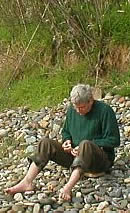
Dan has been teaching for more than fifty years.
His very first course, The Many Faces of the City,
in 1968, guided suburban high school students through the rich ethnic areas of downtown Toronto. It was sociology cloaked in the discovery of new foods, different languages, unusual smells, colors and objects.
That is an approach he has continued throughout his teaching life: Just let people discover or resonate
with the wondrous realities around them.
Teaching is really just setting a good table; inviting people to join, to share what they know and who they are. It's creating--weaving-- a place or moment in time and space when people, in a group, can actively discover more about their own livliness and the delight of working with others. This approach trusts that learners can be partners in their own educational experience.
Dan has been a professor in graduate and undergraduate programs but always felt tired by the institutional gravity. Even as faculty at arts and craft centers, he felt workshops dampened delicate primal curiosity by the implied connection to "work", to get your tuition's worth.
His years at The Omega Institute, from 2000, have allowed him to develop a fluid balance between the need for the clarity and order of teaching about tools, techniques and materials and the equally important need for how this all "fits" into the life of the learner. This has brought him to Casual Alchemy, a form of Creative Coaching: exploring non-traditional ways of learning, to accommodate the changing needs of learners
Models and Metaphors for this approach
Haiku is the inspirational model for this group. It is short and to the point. Yet it incorporates something of the season, the Moment, something of the heart, the Personal, and something larger, the Eternal. There is a discovered Ah Ha.
The "Haiku Ginko" is an organized walk where people come together to experience the same walk through nature as the basis of the haiku they'll be writing. We've done them here in Warwick in the cemetery and in the woods. . We are both together and alone.
MORE on: Weaving Pot Luck
Experiments in Casual Alchemy
2023 Several meetings at the local library on the topic of
Creative Aging A term for pleasantly cloaking the basic human need to figure out the ways through transition. Also in 2018 and 2019
Making your Way into Shadow, Mini workshop in Making as a Language of Shadow Exploration at meeting of the Association for the Healing Powers of the Imagination, April, 2023, Stone Ridge, NY
2022 Working with the Creative Unconscious, ZOOM event with The Omega Institute from Dan's Warwick Workshop
2021-2000 Workshops at Omega
2017-2001 Woodlander Gatherings
2009 a six-week on-line group for people who want to be in the virtual company of others who are making things in the Spirit of the Imagination. It emphasizes accident, coincidence, dreams and things lost and found. A group of us "associates" for six-weeks... creating a virtual alembic in which we all cook a bit differently than we do alone. It's really just a time to help yourself focus on some lingering creative interests. That's where Dan comes in as the "coach"... or weaver, helping keep your attention focussed--lightly--on tasks you've identified.
2007 Learned from the 2007 on-line Salon:
This is an Imaginal Environment and not a curriculum. People will react to it differently. People will work at different speeds and intensities and side projects and discussions between people will appear. Some people will just want to watch what’s happening; others may engage very actively. It all depends… see a record of that course at www.imaginalinstitute.com/imaginalcards.htm
We encountered the indirect nature of virtual community.
Virtual community is built in spirals, twisting up and down, in and away. Nobody is standing still in front of you for very long. The geometry is not the line, the rectangle with its sides, not the circle. Ach, that spiral. The coffee keeps spilling!
Virtual community is built in real time, not linear time.
If we all convened at a room for two hours a day for four weeks, that's one kind of community. That's a kind we've all grown up with. Clear requirements and obligations... and probably some shared rules on how to behave when we were there. In virtual community, that's not the way. We are released from that slightly medical model of behaving... "Oh, sick Students, Come Here and I will diagnose and prescribe. You shall see yourself reflected in the sickness of others and ye shall get well. Just do what I tell you. 12 steps... homework, sponsors..."
Virtual community thrives on misbehavior, on pathology. (Have people really read all the course materials?) So virtual community honors the complexity of soul-time, where nothing is really a pathology and time is not measured.
Virtual Community is viral. Beacuse the rules are altered, violated, things seep in and linger, not unlike Lyme disease. From my own on-line seminar experience in 2006, I had intense reaction to another person and it stayed with me in a way that I have found very supportive... but only a year later. Again, it reflects a shift in expected time frame. Everything does not start and end in The Course. Actually, nothing really starts in the course... it already has... and nothing really ends with the course. It can't. So the Course is a imprinted experience, waiting to become more or less active at another time.